

Education and resources for health professionals
National strategies, policies and guidelines
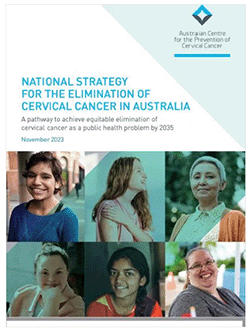
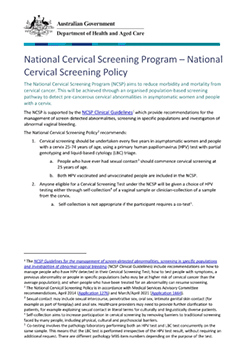
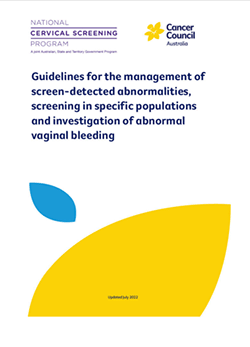
Importance of self-collection
Self-collection provides a level of control and choice for patients, removing a significant barrier to participation in screening.
There are some groups that are less likely to screen, including:
- Aboriginal and/or Torres Strait Islander women
- people from culturally and linguistically diverse backgrounds
- people who identify as LGBTIQ+
- people with disabilities
- people who have experienced sexual violence
- post-menopausal women
- people who have had previous negative cervical screening experiences.
Self-collection may be more acceptable to these groups.
Recent evidence (external site) has shown that the sensitivity and specificity of HPV testing to detect CIN2+ in self-collected samples were similar to those for clinician-collected samples when using validated PCR-based HPV assays.
Recommended
National Cervical Screening Program (NCSP) Training Bundle (external site)
An in-depth course created by the National Cervical Screening Program (NCSP) for doctors, nurses and midwives. RACGP accredited.
Optional
Changes to cervical screening intermediate risk pathway (external site)
Self-collection of Cervical Screening Tests Online Module (external site)
Recorded webinars
Navigating the National Cervical Screening Program: how to optimise self-collection (external site) [1hr 3min]
Taking a cervical screening test (external site)
Meeting the cancer screening needs of the LGBTQA+ community (external site) [44min]
Enhancing early detection: The latest in cancer screening (external site) [1hr 30min]
2025 HPV Webinar (external site) [1hr]
Optimising cervical screening for people with disability (external site) [1hr 29min]
Face to face training
Sexual Health Quarters: Clinical education for Nurses and Midwives (external site)
Sexual Health Quarters: Clinical education for General Practitioners (external site)
For more information contact the SHQ Clinic Education Coordinator (08) 9227 6177 or email clinic.ed@shq.org.au.
National Cancer Screening Register (NCSR) guides
The NCSR Healthcare Provider Portal and integration with Clinical Information Systems enable healthcare providers to access patient cervical screening information, submit forms electronically and manage their patients’ participation.
Quick reference guides
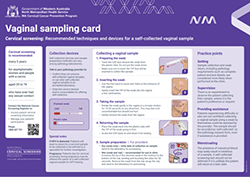
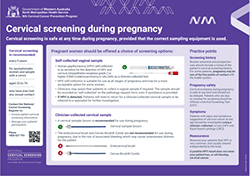
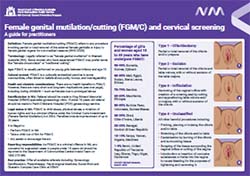
Resources to use with priority populations
Screen Me! campaign and resources (external site)
The Screen Me! website has useful information and resources for health professionals and disability organisations about cervical screening for people with disability. Funded by the Australian Government.
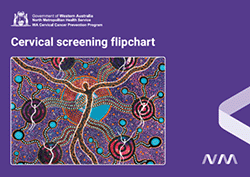
Cervical Screening flipchart for Aboriginal women (PREVIEW) (PDF)
Developed to raise awareness among Aboriginal women and encourage the uptake of cervical screening. To order a copy of the flipchart, please contact the WACCPP.
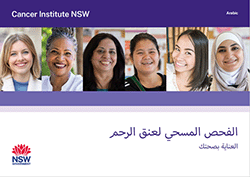
Cervical screening flipcharts in 16 languages (external site)
The Cervical screening – taking care of your health flipchart and facilitator manual (Cancer Institute NSW) have been designed to support those providing information on cervical cancer and cervical screening to women from different cultural backgrounds.
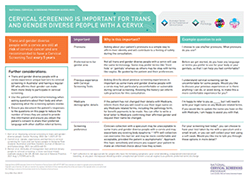
Cervical screening is important for trans and gender diverse people with a cervix (PDF)
A guide for health professionals covering important personal and clinical considerations when supporting trans or gender diverse patients doing cervical screening. Developed by the Australian Centre for the Prevention of Cervical Cancer, ACON and Transhub.

Own It campaign stakeholder communication toolkits (external site)
Own It is an Australian Government–funded national campaign to raise awareness of the self-collect option when doing a Cervical Screening test. Assets are available for First Nations and LGBTQ+ communities, as well as in Arabic, Hindi/Punjabi, Mandarin, and Vietnamese.
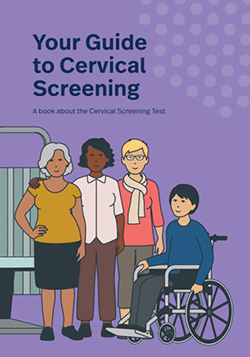
Guide to Cervical Screening Book (external site)
For use with people living with a disability, made in partnership with the Sexuality Education Counselling and Consultancy Agency (SECCA)

Resources for women from multicultural backgrounds
Resources in languages other than English, how to guides and videos developed by the National Cervical Screening Program.
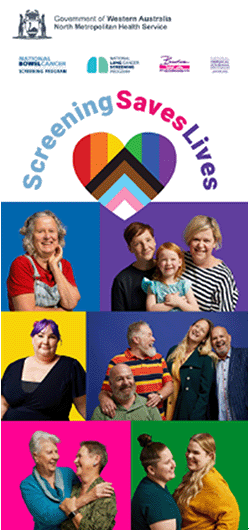
Screening Saves Lives campaign and resources
The Screening Saves Lives campaign is a collaboration between National Bowel Cancer Screening Program, BreastScreen WA, WA Cervical Cancer Prevention Program and the National Lung Cancer Screening Program with a focus on the LGBTQIA+ community.
Resources for the community can be found on our WA Campaign page.
Order WACCPP resources in hard copy or contact:
WACCPP
Tel: (08) 6458 1740
Email: cervicalscreening@health.wa.gov.au
Other resources for health professionals
WA Primary Health Alliance
Clinician Assist WA (external site)
National Cervical Screening Program (NCSP)
Understanding the National Cervical Screening Program Management Pathway (external site)
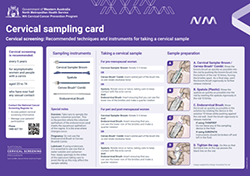
Cervical Screening Test: How to take your own sample (external site)
Pathology test guide for cervical and vaginal testing (external sites)
Colposcopy and Treatment form (external site)
Understanding the NCSP Management Pathway (external site)
Australian Centre for the Prevention of Cervical Cancer
Information Sheets (external site)
Sexual Assault Resource Centre of WA
Subscribe to cervical screening updates
Cervical Insight newsletter
Cervical Insight’ is a newsletter for health professionals published by the WA Cervical Cancer Prevention Program (WACCPP). Subscribers will receive news on the latest updates to cervical screening policy, practice and guidelines, education and training opportunities, resources and research.
To subscribe, email cervicalscreening@health.wa.gov.au.
Community Cervix Announcement newsletter
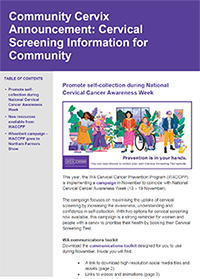 Subscribe to the WACCPP ‘Community Cervix Announcement’ newsletter to receive news and updates on cervical cancer prevention initiatives in WA. To subscribe, email cervicalscreening@health.wa.gov.au.
The newsletter provides ideas on how the WACCPP can support you in preventing cervical cancer in your community. It will also keep you updated on developments and showcase the great work occurring throughout WA.