

Memories of King Eddies
A collection of stories from former King Edward Memorial Hospital (KEMH) staff and patients are provided below as part of the KEMH Staff and Community Story Quilt.
WA's first obstetric and gynaecology sonographer
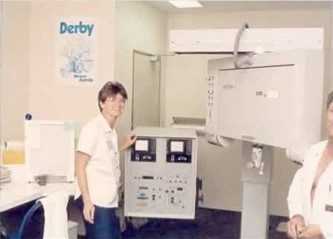
Rae Roberts with a Diasonograph static scanner ultrasound machine.
I began work at KEMH as an Enrolled Nurse in 1973 and progressed to become WA's first obstetric and gynaecology Sonographer.
For 40 years I was privileged to manage the KEMH Ultrasound Department which was acknowledged as the busiest women's ultrasound department in the southern hemisphere and well regarded for being at the forefront of ultrasound research such as The Raine Study.
My ultrasound career started in 1973, when I was asked by the Medical Director Dr Stanley Reid, to assist him with operating the first obstetric ultrasound machine at KEMH which was called the Diasonograph. It was a B mode static scanner; who knew what that was? The challenge of this new ultrasound imaging technology was that nobody in WA knew how to use it for obstetrics.
Bruno Humsky, an electronics technician, taught me how to set up the machine each day and how to calibrate the speed of sound through tissue and water. A single beam of ultrasound was moved manually across the pregnant abdomen to build up an image of the fetus. There were many restarts to each scan to get the correct image a fetal head because the baby often moved.
Dr Reid and I would scan about 10 pregnant women each morning, measuring only the bi-parietal diameter (BPD) in the coronal plane from leading edge to leading edge of the skull bones just above the ears. Charts had been created overseas that related the BPD to gestation of the baby; therefore, an estimated date of delivery (EDD) could be calculated.
Initially at KEMH we repeated each baby's head measurement three times over 8-10 weeks so an average of EDD's could be used. After about 12 months of learning, we were more accurate and able to rely on one BPD to calculate EDD and we recognised amniotic fluid, placenta and other fetal structures on the display screen which was a 10cm square green cathode ray oscilloscope.
Late in 1974, I was excited to tell Dr Reid that I believed we were seeing conjoined twins. The Diasonograph display screen showed two oval echogenic structures very close together. We eventually agreed this was indeed conjoined twins.
It wasn't until the 1980's when real time ultrasound imaging was introduced that you could see the baby moving and freeze the image to make a measurement on the screen. Thus, fetal ultrasound became easier, faster and more accurate.
Next at KEMH came a waterbed style ultrasound machine, called the Octoson, where the pregnant woman lay stomach down with eight transducers scanning from beneath the waterbed. This was a cumbersome piece of equipment and soon phased out around the same time as when KEMH acquired a phased array portable real time ultrasound scanner that I used to display the brain anatomy inside a newborn baby's head.
In 1989 multiple pregnancies were on the rise due to in-vitro fertilisatio. When scanning one day, I believed I had discovered quintuplets! Dr John Phillips was the supervising Obstetrician, and he was quite difficult to convince. That year both quadruplets and quintuplets were delivered at KEMH with just a few days between their arrival. The Neonatal Intensive Care Unit staff were very busy caring for nine preterm babies! But all went well and today, those nine adults are enjoying their professional and family lives thanks to the dedication of everyone at KEMH.
There have been many more ultrasound technology advances during my 50 years in obstetric ultrasound such as the anatomical detail seen on computer generated 3D images and 4D video sequences. Using the Doppler properties of ultrasound has been common for over 20 years to measure fetal blood flow to and from the placenta and the fetal brain.
Recognition of normal and abnormal anatomy plus building a library of images in your brain is what makes an excellent and talented sonographer. My job never felt like work because the frontiers of ultrasound were ever-changing, and I had an expert team of sonographers and doctors working with me.
Rae Roberts
Former KEMH radiographer
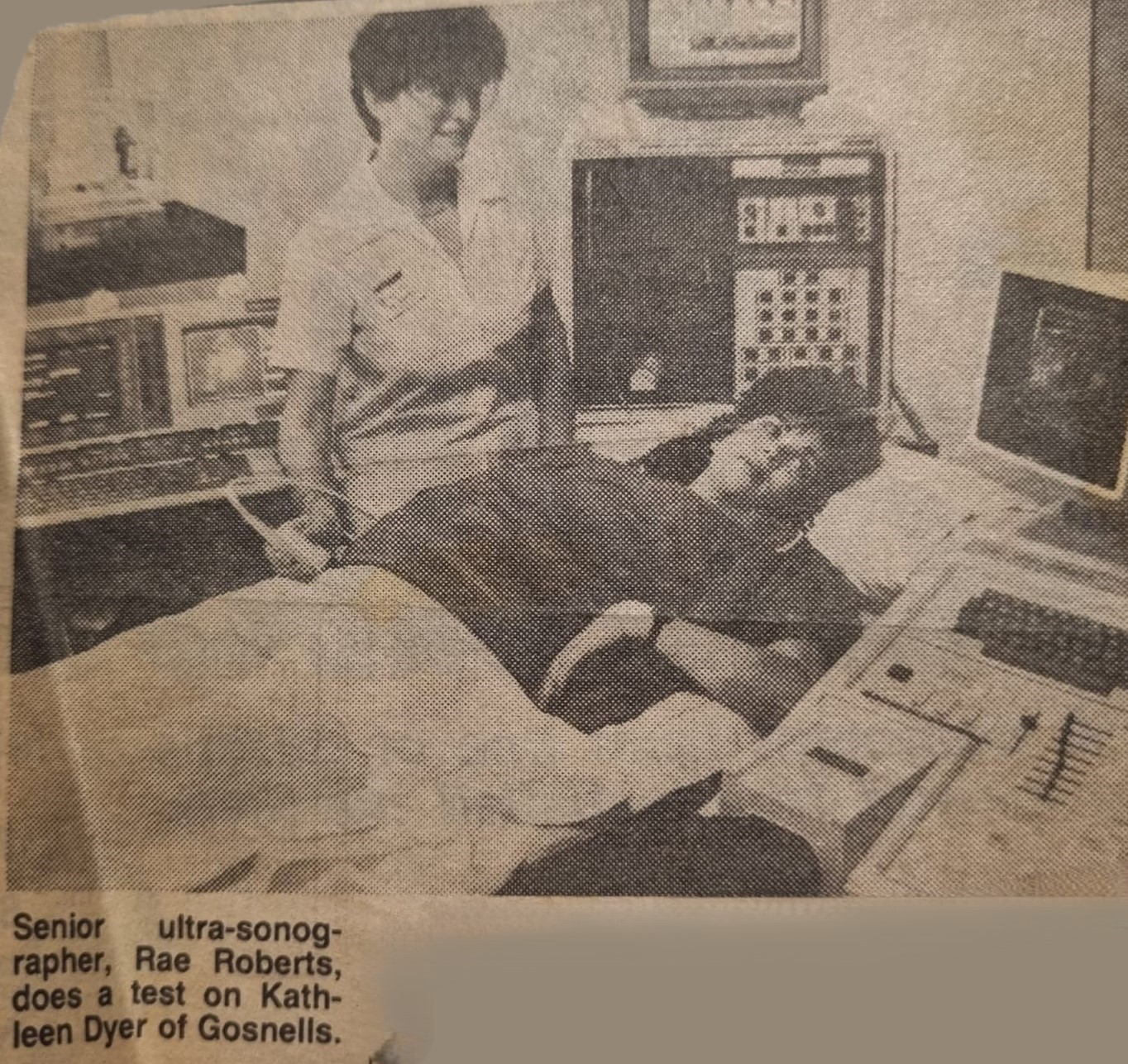
Rae Roberts with a Doppler ultrasound machine supplied by Prof John Newnham. We listened to the high pitch audio sound of blood flow through fetal umbilical cord; testing to be sure we could gain the skills required to conduct the Raine Study.
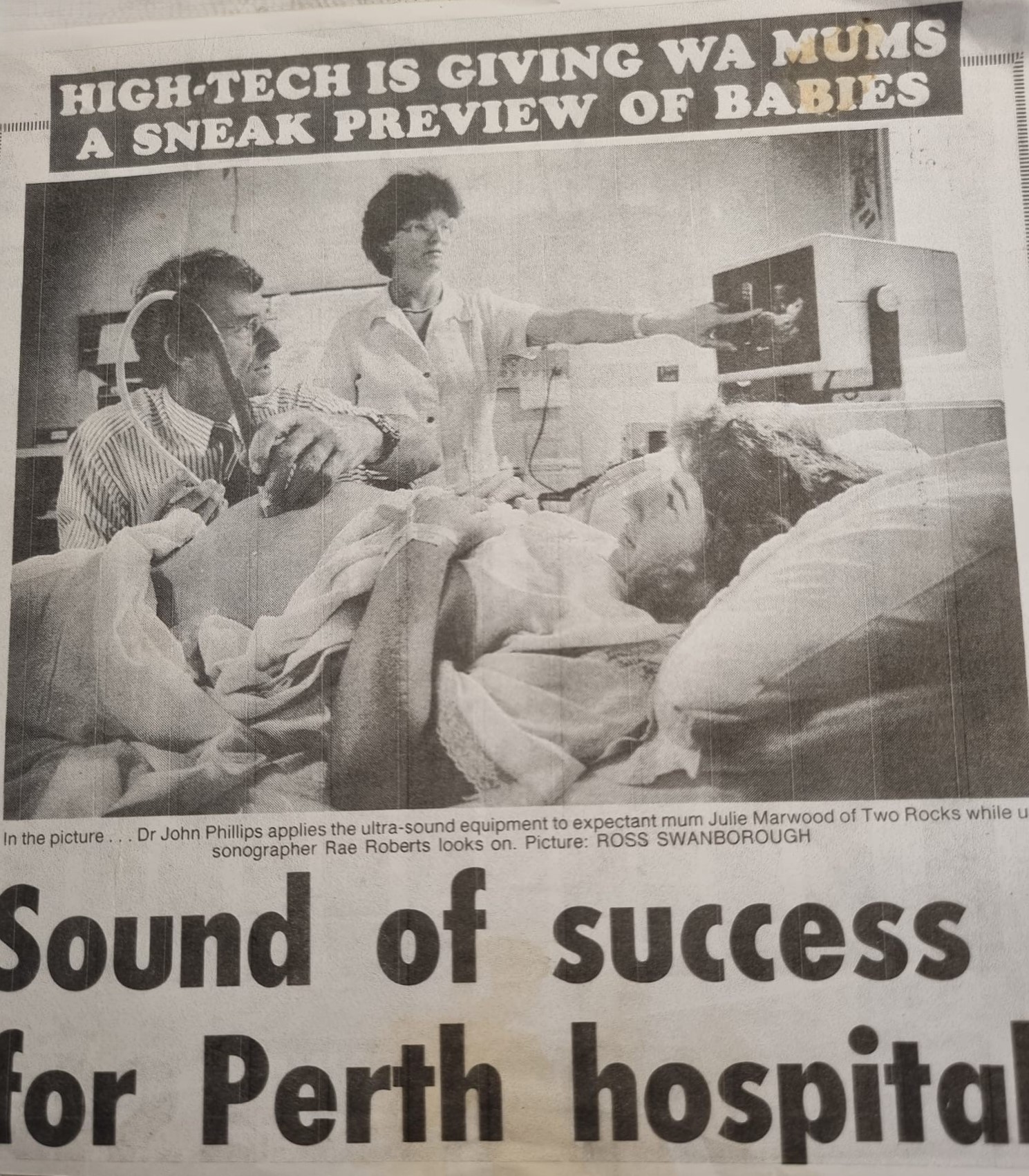
Dr John Phillips seen with new 3.5mhz curved array real time ultrasound transducer to measure systolic/diastolic ratio in fetal umbilical cord.
Long term support and friendship of colleagues
My 30 years working at KEMH are centred on the feeling of being a valued member of our department. I felt I had found my tribe and could make a difference in women's health.
Starting at KEMH in 1976, my love of learning saw me study for and complete a post graduate Diploma; and later a Master of Science by research related to breastfeeding supported by work colleagues and equipment manufacturers.
When my first marriage failed in 1980, it was this wonderful group of women at work who listened, supported and later celebrated my journey to happiness with a different husband. Our two children were born at KEMH before it changed to accepting mainly high-risk obstetric patients.
After 10 months of maternity leave, unpaid in those days, I had to overcome some initial administrative concern to return to work part time. This had not been done before in that department. My direct line managers supported the concept which was unusual in 1985 and 1988 perhaps knowing their job share people were reliable professionals and friends too. We had an informal agreement between ourselves to cover for one another during school holidays or when our children were sick, so the boss always had someone at work.
Forty years later, it seems that flexitime and work-life balance have caught on everywhere. KEMH has definitely been an integral part of my life. After retirement, I still meet up with several ex-staff on Monday afternoons.
Former KEMH staff member
(The author wanted to remain anonymous)
The changing face of radiology
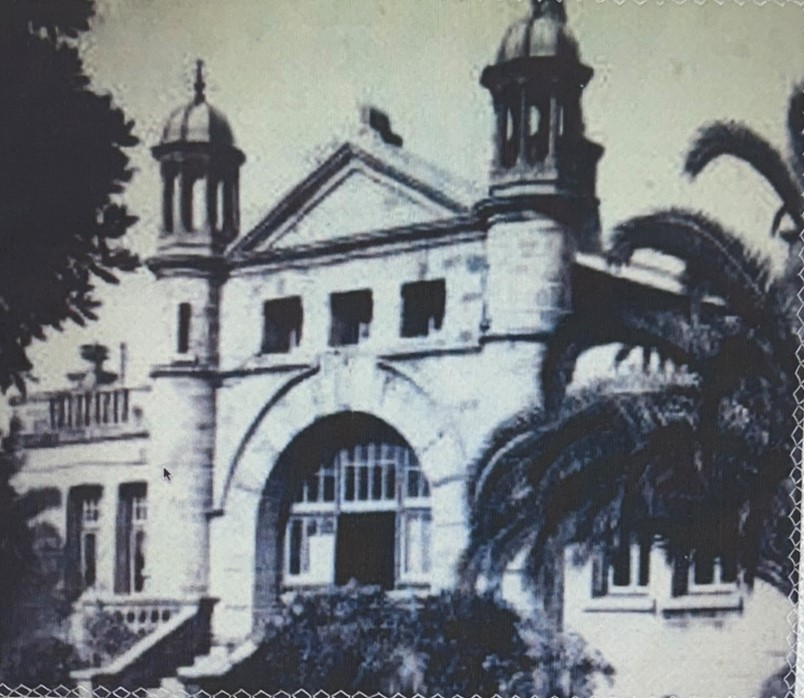
Harvey House where KEMH X-Ray Department was located in the 1960's at the left side of this picture.
I was a radiographer working at KEMH when the X-ray Department was located in the matron's flat area of the original hospital building at the bottom of the hill near corner of Hensman and Barker Roads. That building is now called Harvey House where the WA Medical Museum is located. I want to share a couple of memorable situations that would not occur these days.
There was a patient in 1969 who went into labour on the x-ray table. We called the obstetrician but by the time he arrived after running down Hensman Road from the Antenatal Clinic, Sister Kenny (Senior Radiographer who was also a midwife) had successfully delivered the baby.
In the 1970's patients needing an x-ray also had to be wheeled outside and down Hensman Road on trolleys - rain or shine - with staff holding umbrellas when necessary until they reached the original X-ray Department on the corner of Barker and Hensman Road!
About 10 years later ultrasound scans replaced x-rays of pregnant women and this situation would not have occurred after 1980 because bedside ultrasound machines had been invented.
I recall in the 1970s when consultant radiologist Dr Peter Breidahl would drive from his private practice in West Perth wearing dark red goggles to adapt his eyes to the dark he would encounter in the x-ray room. This was so he could perform barium studies to image the stomach and bowel of KEMH gynaecology patients. At that time x-ay technology had not progressed sufficiently to create image intensifier tv-like screens that could be operated in daylight which have themselves been replaced now by digital images stored and displayed on computers.
Another young paediatric consultant in the late 1970's often needed to arrive very quickly from his home in Mt Lawley to the Special Nursery to attend to sick newborn babies. This paediatrician was known to shake his stethoscope through the car window, while the police waved handcuffs back at him, as they escorted him safely to King Eddies.
N. King
Former KEMH radiographer
Remembering my time at King Eddies
I retired in 2022 after joining KEMH from the UK in 1992. Despite a considerable culture shock between the status of midwifery in both countries, the close family like relationships at KEMH became evident very quickly. In fact, I seem to remember thinking that most of the staff had been born at KEMH and never left.
KEMH offered midwifery training and education from its opening in 1916 until 2021, which was later than any other hospital-based midwifery course in Australia, certainly seen as the end of an era having prepared thousands of midwives. My most memorable time at KEMH was when my own daughter gave birth in water on two occasions, having been cared for by a midwife in a continuity of care model. I believe that this is how midwifery care should be offered to all women.
Since retiring I have continued to be actively involved in the Australian College of Midwives Midwifery History Project Group that is responsible for the development and maintenance of a national resource to preserve the history of Australian midwives and midwifery. I am committed to ensuring WA and KEMH feature in this work.
I also want to recognise my past colleague, Graeme Boardley, former Director of Midwifery, Nursing and Patient Support Services, who retired in July 2026 after 42 years as a nurse and midwife. I first met Graeme when he was a midwifery student of mine in 1993, little did I realise that he would later become my boss, mentor and friend.
He was the first male appointed at an executive level in the history of KEMH, which is significant in a profession with only a small number of male midwives in Australia. Graeme has always been willing to take a stand and advocate for services that make a positive difference. He has been guided by his own mantra; “If you promote and protect the health of women and babies, you improve the health and wellbeing of future generations”.
His many achievements leading practice change includes the implementation of Midwifery Group Practice, the implementation of water birth as an option for women in WA, the development of the WA Safe Infant Sleeping Policy and development of a policy for publicly funded home birth.
He is passionate about First Nations maternity and women’s health and through his innovative leadership was instrumental in the implementation of the Aboriginal Midwifery Group Practice program at Women and Newborn Health Service.
Graeme is also well known for wearing many multi coloured ties, socks and on occasions jackets as well as being renowned for his famous cheesecakes. He has been actively involved with the KEMH Alumni and proud supporter of capturing the history of KEMH.
It has been a privilege to have worked alongside him for so many years.
Janice Butt
Former Coordinator of Midwifery and Nursing Education and Research
A special place in my heart
KEMH will always hold a special place in my heart - both as a radiographer and as a birthing mother.
I started work there in 1981, shortly after immigrating to Australia. The friendly, welcoming team in the X-ray Department helped integrate me into the larger family of King Edward. Working as we did alongside nurses, paediatricians, radiologists, obstetricians, I always felt respected and appreciated.
Two of my three sons were delivered at KEMH. I would award, without hesitation, gold stars for the treatment and care I received on both occasions. Being the patient instead of a member of staff was the perfect way to fully appreciate what an excellent facility KEMH was and I am sure, still is.
During my relatively short time of 10 years work at KEMH and the cross over between being a member of staff and a patient I have some unique memories, I’d like to share one of them.
While pregnant with one of my sons, I still laugh at an event when called in to work in the middle of the night to do a chest x-ray on a tiny premature baby in the neonate nursery. As normal, I popped my head in at the hospital reception to inform them I had arrived and was heading to the nursery. Walking briskly up the corridor I became aware of hurried footsteps behind me. I was being chased by an anxious new receptionist who didn’t know me personally. She was very concerned at my large late-stage pregnant body.
My baby was born a few weeks later weighing almost five kilograms. She had mistakenly thought I was a patient!
Marjolijn Godrich
Former KEMH staff member